I’ll say it again, I didn’t expect to get so much out of my Scion campaign, not a week’s worth of content. But it’s time to end it with this last little piece. This one isn’t about plot, as I’ve already covered the Hero, Demigod and God story arcs, but a series of anecdotes and funny moments that happened during the game.
As with every article before this one, please refer to the Scion Primer I posted on Monday in you have any doubts, though you can drop me a line in the comments and I’ll clear anything up of course!
I hope you’ll forgive the overwhelming lack of images on this post, couldn’t find any that were good enough to go with the stories. But you know what? I think I’ll get them done, immortalise the stories with some art by my favourite artist. Continue reading Godly Affairs – Part V – Memories
Robots and strange creatures are taking over worlds, sent by an evil mastermind. But not all hope is lost, Mike and Dorian are still here, kicking butts as only Zheros can! Continue reading Review: Zheros
It’s been a while, hasn’t it, since a game mechanic has bothered me so much that I had to unpack the Annoying Game Mechanics section of The Mental Attic for a nice rant. But as I’ve been streaming and recording Let’s Plays in the past few months, and perhaps because of my choice of games, there are two that have really gotten on my nerves.
As with every Annoying Game Mechanic in the past, this is a mechanic that when done right it’s awesome but when done improperly it just makes you groan. A friend once said that the definition applies to all mechanics, and he might be right, but some mechanics are always awesome and others are always bad. Those in the middle, I call them annoying.
But let’s get down to business. The mechanics I’m bothered about right now are Companions and Romance. Yes, since it’s been a while and these two are connected, I’ve decided to go for a twofer. But it’s going to work a bit differently. I’m not gonna go into multiple examples, just a couple for each and explain why they’re good or bad.
It’s up to you to decide is this is a romance or just friendship, but it’s indubitably pure human contact!
You might wonder: is Romance a mechanic, or is it part of the narrative? In most cases I’d say narrative, just an element of the storytelling, to connect two or more characters together, to give us something to care about. But when the relationship is quantified, when the attraction and the closeness and intimacy have defined values that you can alter with items or a choice in a conversation, then it becomes a mechanic.
The problem with Romance as a mechanic is that as I mentioned in last week’s Writing a Novel guide, one of the pitfalls of the romance genre is the lack of characterisation on the couples. You have characters with barely any personality and you expect the players to feel love for them. Or maybe they’re bland and live and breathe by your words and your gifts. How can that mechanic be satisfactory? How can it convey the beauty that is human relations or the heartbreak of a love lost when it’s so artificial? You fall in love with people who challenge you, who make you realise the stupid things you think or say, the ones you tell yourself or told to you by others. You fall in love with people who make you change for the better, who make you question the things you just accepted so you form your own conclusions. You fall in love with those that force you to face your fears head on, because just being with them brings out the courage you thought you never had.
She has doubts, dreams, joys and fears, just like any other person! (Image Credit: Giantitp.com)
One of the best romances in games for me has always been Revan and Bastila in Knights of the Old Republic. Your character is a blank slate, but you give him the personality with every choice you make. You embody him and he becomes a well-rounded character. Bastila on the other hand has a defined personality, she’s haughty and proud but it’s all a front for doubts and impossible burdens placed on her. She’s vulnerable and that makes it hard for her to connect. And it’s not through gifts that you connect with her, or a simple choice of “let’s do this,” but something gradual, through hundreds of conversations. You talk to her about her worries, about her values, you get to know her fully before you pass that romance checkpoint, so when you do get to that place it feels more natural, because you got there through the gaming equivalent of pure human contact.
The worst romances on the other hand are in Dragon Age origins and Jade Empire, two Bioware games released after Knights of the Old Republic. Each has one of the sins and rides it into the sunset. Dragon Age Origins lets you buy affection with gifts and you can skip the human contact of dozens of conversations by just showering your would-be partner with lavish gifts. It doesn’t feel like a romance, more like a business transaction that ends in an intimate moment.
To be fair, it’s not just the romance, but also the dialogues that are wooden! (Image Credit: Penny Arcade Forums)
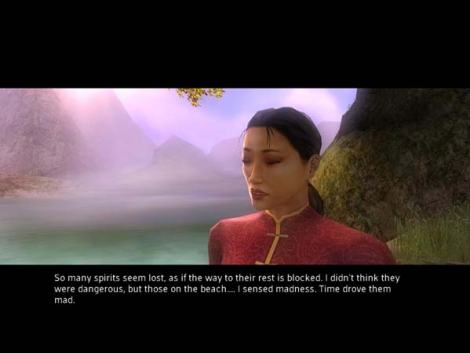
Jade Empire on the other hand suffers from bland characters, women and men with almost no personality. They rarely have their own opinions and some even state yours is all that matters to them. They don’t feel human even if the most basic of ways: thought. How can you connect with them then, how can you connect to a doll or a puppet? Jade Empire romantic interests have no soul.
Companions are a part of a game that goes beyond the narrative and extends to the gameplay itself. A companion is a supporting character, someone there to help you fight or to give out clues on how to solve a certain puzzle. You might have a single companion or you might have a few of them trailing behind you. Sometimes you can play as the companions, choosing their abilities in battle or just making them your main character for a while.
Companions have their own mechanics associated to them. They have underlying systems controlling their behaviour, abilities and even power levels. Sometimes you can talk to them and find out more about them, even romance them if you give gifts or engage them in meaningful ways. Sometimes you can raise your connection or affinity to them to unlock personal quests or just more bonuses in battle.
By the time you get here, the AI and you will be an unstoppable team! (Image Credit: Bored Nations)
Good Companion mechanics are those where the party NPCs don’t get in your way, or their AI is good enough they fight battles as well or even better than you would. Knights of the Old Republic, as fun as it, is has horrible companions in this regard. They’ll often get lost on the way, walking or running slower than you do, making you waste precious time because you can’t exit a room unless your party is all there. In combat they rush their enemies even if they’re ranged characters and unless you take the time—which you often have to—to select their abilities, they won’t use their powers or weapons effectively. Force using characters are worse at this, missing out on disabling enemies because their AI just goes for Saber Flurry.
Dragon Age: Origins (and only Origins) companions are fantastic. They react to your attacks, often creating combos that you might not be aware of, or setting those up for you if you have the right spells. Through their automated example you learn how to create proper strategies when fighting most enemy types.
Jade Empire, despite its wooden romances, has an interesting take on companions, as you can set them to offense and support. In offensive mode, they attack enemies just as you, often taking some of the heat off your back and giving you a chance to take out enemies one by one. In support though, they sit around in a meditative pose and give you a passive bonus, though those are quite unbalanced to be honest. Only Dawn Star is of particular use, as she can restore your Chi—read Mana.
They help in combat, but they have their own love interests! (Image Credit: A Most Agreeable Time)
Companions and Romance often go hand in hand, especially in Bioware, they can’t NOT do romance and companions—and it’s why I used them for my examples and not others. It’s their signature and people expect it, though I wish all their games had the depth of humanity that the Knights of the Old Republic romances had. But sometimes you get games were companions and the romance are independent of one another, where the affection is left to the narrative. Xenoblade Chronicles fall into this category, where the companions’ feelings towards one another are part of the script. Their affinity with you only determines mechanical benefits, but there is no pursuit of romance, and it’s better that way to be honest. I’d rather have my character pick their partner because it’s part of the script, than have to romance a character with no soul.
But what do you think about companions and the mechanics of love in video games? Do you have memories of a truly human connection in a game, or do you ignore them because they’re pointless and artificial? How about just companions, do you have any thoughts on those? I skimmed on examples this time just to rant a bit more, but I’m keen to hear other examples of good and bad!
A few weeks ago I wrote you about how to handle action scenes in novels, in terms of length, details and overall pace and flow. At the end of the article, and as always, I mentioned I’d be providing samples for it, an example of a short scene and a long one, to show the points I made and concepts I introduced.
The following are those scenes. The first one is a short duel between two swordsmen, set in the fantasy universe I developed during the first issues of the guide. The second is a longer scene, a shootout between a private detective and criminals.
In the past I’ve spoken of Annoying Game Mechanics, of those that we find in games and after so many uneven implementations we instinctively groan when we see them again. But not all game mechanics are annoying, not all have good and bad moments. Some mechanics are just freaking AWESOME! Continue reading Awesome Game Mechanics – Free Flow Combat
Last week we had the last of the Editing Samples, and so I’ve gone over the First Draft, Second and Streamlining. As mentioned in those articles, I skipped ahead a bit. Those scenes could’ve done with considerably more effort, but it was enough to demonstrate how a prose might evolve through several editing passes.
As I promised, after finishing up with the different stages of the novel writing process, I would turn to guiding your through specific genres and scenes. The first I’ll be exploring are Action (and/or Combat) Scenes. Continue reading Writing a Novel – Action Scenes
Annoying Game Mechanics are those that just make you groan when you see them in a game. You’ve seen them at their best but you’ve also seen them at their worst. You can’t love them but you can’t hate them either, but you can definitely be annoyed!