Starring a group of adrenaline junkies with no greater joy than beating the crap out of each other while racing up buildings in the middle of demolition, the game is fast-paced, acrobatic and extremely fun to play with others. I believe they have plans for online multiplayer but the local was fantastic, as I played against 2/3 of the team. They thoroughly kicked my ass of course, but at least I won 2 rounds. This is a four-on-four race and combat, and you need to win 3 straight rounds against your opponents.
You have two ways to do this: you either race to the top and reach the roof or you beat up everyone else. Having a lead on the race to the top is also a valid combat strategy because the one at the top determines how fast the screen scrolls up and if you fall under the lower screen limit, you take massive damage and respawn further up. It’s very similar to how Super Smash Bros. works in terms of leaving the stages.
The controls are fairly simple but it takes practice to master the movement and combat. You can jump and attack, but the jump distance and momentum depends on the angle of the debris you’re using as support. With the right angle, you can shoot up past your enemies and take the lead or an ineffectual little hop before you die, as I did for most of the match.
This game had one of the funniest inspirations of any game I saw at Rezzed: the art, plain and simple. The development team were big fans of the artist’s work and just created a game that would let them use it. To be fair, the art is pretty awesome.
With a game like this one I asked what game modes there were, as I figured some people might get tired of the frantic combat and it turns out there is a secondary pure racing mode, without HP and where you just need to make it to the top. You can still fight and kick and throw things at your opponents but they won’t die, which to me adds a lot more tension.
Speaking of throwing things, one thing I loved doing while I fought them was hit debris their way. When I did it right they tumbled way down and had to make their way back up. The downside was they then went after me because of it! Too vindictive these guys! They later told me I was right in hitting debris, and that it was one of their favourite strategies because if you pulled it off it was incredibly rewarding.
The game’s still in Alpha Stages but I loved what I played of it. And I will definitely organise a tournament as soon as I get my hands on a build, so we can all enjoy it and have tons of fun!
Goodbye Deponia is the last instalment in Daedalic Entertainment’s Deponia Trilogy, finishing the story of Rufus, Goal and the doom of the junk world Deponia.
The Good
Charming visuals
Creative ingenuity puzzles
The Bad
Moon-Logic-centric
Unlikeable cast
Convoluted plot
Goodbye Deponia picks up right after the events of its predecessor, with Rufus, Doc, Goal and Bozo on their roller car. Things seem to be going smoothly until Rufus messes things up and causes the roller to be destroyed, forcing the team into hiding while trying to stop the destruction of Deponia.
From the start, this game showed me its greatest flaw: characterization. In the past two games Rufus has always been selfish and self-absorbed and both a genius and a klutz, and it was disappointing to see that two outings hadn’t been enough to make him mature or change a little bit. Rufus is extremely unlikeable as a protagonist and makes it difficult for the audience to give a damn about his antics. Most of the secondary characters remain the same as they’ve always been, and while there are a handful of characters that do change, the game makes a point out of destroying their lives so they revert to type. By the end, I just wanted all of Deponia, including these flat characters, to die a horribly slow death. I was offended that they decided to dismiss Rufus’ asinine behaviour with this cop-out excuse: he’s a clone and programmed not to care about anyone’s life. It’s lazy writing.
Using food and condiments to clone. I’m not kidding, it’s this weird
The plot is a convoluted mess. Every title in the series has gotten close to having Rufus and Goal reach Elysium, only to have something happen at the last minute, which derails the plans, and Goodbye Deponia does it again, giving me the impression that the plot was artificially inflated just to extend game-time. It’s even more apparent when the logic and argument behind the roundabout are so weak. Another proof of extended plot is the fact that at one point you control three Rufus clones, each with their own missions and puzzles that make the game feel bloated.
The writing and humour themselves are much hit and miss. There are very funny references and Rufus’ “We are Asses” speech near the end is fantastic, but in most cases the jokes are downright offensive, coming off racist and sexist at best. It’s made even more disgusting by what I previously mentioned: you are forced to wreck other people’s lives to make progress. There’s a sequence involving a Monkey and a Grinder that is very offensive. I am not politically correct, but there’s offensive-funny and Deponia misses the mark on that and goes straight for simply offensive.
The Bozo family house has a built in laugh track and some atrocious writing!
The gameplay is standard point & click adventuring, with puzzles coming in two varieties: inventory based and ingenuity puzzles. Inventory based puzzles are very annoying and often require obscure and frankly obtuse leaps of logic to which “Moon Logic” doesn’t even apply anymore; Mars logic is more apt. You have to combine almost random items with each other in order to progress. The randomness is the most apparent with the spiced-up pie you serve Bozo, an old vending machine with toothpaste, dust, pepper and other nonsense put on top. It doesn’t make much sense, but you get through it just by trial and error.
Ingenuity Puzzles are the real gem in this game as they take a step back from the convoluted logic-leaps and just have you use your wits. From a Disco-themed puzzle in which you need to keep cameras from seeing Goal to a tapeworm removal surgery puzzle. They’re a much-needed break from the moon logic madness that plagues the game and I’m sad there weren’t more of these puzzles.
This puzzle was very fun and creative!
Sound-wise, it has good voice acting and the hobo-singer between acts remains the best of the series. Background music however, tends to get a bit repetitive, especially in areas with plenty of backtracking. My biggest gripe however, comes with Cowboy Dodo, and annoying new character, which has a couple of appalling musical parts.
Deponia has always been charming in its derelict kind of way and with its cartoonish visuals and the third installment brings more of that bizarre and goofy goodness. Environments look shabby and downright uncomfortable but they work for Deponians. Items are easily identifiable and character animation is very good. I do have mixed feelings with the animated cutscenes though. Some of them look very good but others, especially those with plenty of ‘action’ look like cheap flash animations.
Some cutscenes look really well!
In the end, Goodbye Deponia closes the trilogy with a bittersweet leaning towards sad conclusion that would’ve worked even better if they’d taken the proper care to polish their plot and characters. As it stands however, I can’t say I’ll miss it and after playing Memoria, Goodbye Deponia seems to be a step back for Daedalic.
The Mental Attic Score: Wait for a Sale. If you can, get the game in a bundle with the other two, so you can play them straight, if you dare.
The Wolf Among Us is an episodic visual novel game developed by Telltale Games based on the Fables comic series from Vertigo (DC comics). It stars Sherriff Bigby Wolf as he investigates a series of murders happening in the Fabletown community in New York City.
The Good
Beautiful art-style
Strong voice acting
Interesting plot and choices
Good introduction to the Fables universe
The Bad
Quick-Time-Event action sequences are dull
Fables readers won’t find much excitement
The Wolf Among Us uses the same gameplay you’ve come to expect from Telltale’s latest games, a mix of multiple choice conversations with time limits, split paths and quick-time-event based action and fight sequences. It’s solid gameplay if a bit shallow, but let’s look at each of them.
If you’ve played Telltale’s The Walking Dead, you know what it’s all about: Unlike adventure games where you go from place to place solving puzzles in order to move the plot along, in this game you’ll mostly talk to other characters, your choices in these conversations deciding how these characters feel about you. These choices affect future encounters and some of the different outcomes for the season. Some of the conversations and choices are time-based, so you don’t have the luxury of weighing down your options before committing to one, instead having to decide quickly or just follow your gut. It’s workable gameplay but it does feel like if you’re not fast enough the choice is taken from you, which works really well in The Walking Dead but not so much here where the situations are rarely life or death.
Bigby and Colin, best pals!
When you do move around on your own, it’s a typical 3D point & click affair. You move throughout the area and there are hotspots you can click and interact with, but unlike regular point & click adventures where you need to find the hotspots, here they’re pointed out for you so you can move along. There aren’t any puzzles, though, just simple interactions to get more information. Again, it works but it lacks depth.
The other side of the gameplay comes with the action and fight sequences and these are purely Quick-Time-Even driven, as they’re essentially interactive movies. You might get a few choices on how things play out, but you don’t control combat, it’s just a cinematic. The game might prompt you to quickly press W or A or mash Q for an effect, but it’s nothing exciting. In fact, in one of the later episodes Bigby chases suspects through rooftops and avoiding cars and the only thing you do is press the W key when prompted. The scene itself looks really good and it would’ve been exciting if you could do more than just watch and tap.
As you progress more of the Book of Fables unlocks, giving you Bios on different characters and your choices
But, you don’t really play Telltale Games for the depth of gameplay—which is a sad thing to say to be honest. You play them for the characters and story and the different twists and turns that come during a given season. This time around, Telltale drew from the Vertigo Fables comic series. Your protagonist is none other than Sheriff Bigby Wolf—as in the Big Bad Wolf. You see, everyone living in Fabletown is part of a fairytale or folklore. Fables came to our world to escape from an enemy who would’ve destroyed them all and they’ve now settled in their own little community in New York City. Fables are mostly immortal and can heal from almost any wound, though with sufficient damage they die like anything else. But with them being so old, they’re not exactly the same people you read about, not all of them, and not anymore at least. Take Bigby for example, he’s the evil wolf from Red Riding Hood and Three Little Pigs, but he’s in charge of keeping the town safe and one of his best friends is one of the three pigs. Snow White divorced Prince Charming because he was a cheating bastard (consider that in Fables, Prince Charming is the same guy involved with Snow, Cinderella and Sleeping Beauty). Things change, even for Fables. Non-human Fables live in the city only if they have glamour spells to hide their appearance, otherwise they’re sent out of town to The Farm, but glamours are expensive so there’s a black-market, which is one of the central topics explored in this season.
The story is a prequel, set before even the first issue of the comic series. It opens with Bigby getting a call for domestic disturbance at Mr. Toad’s building. The altercation is between the Woodsman, a long acquaintance of Bigby’s, and a prostitute named Faith. Things can quickly get out of hand and I for one kicked Woody’s ass. Then it gets weird when Faith’s head turns up at the Woodlands, the big apartment building where the Fabletown government officials and some of the richer Fables live, such as Bluebeard, Beauty and Beast and Snow.
Some Fables, like Mr. Toad, have a hard time getting their hands on Glamours
Tracking the killers take Bigby throughout Fabletown, tracking leads on his own or with Snow. Their chemistry is really good and their scenes together are fantastic, though having read the series I’m a bit biased because I know how things turn up, so a part of me wanted to direct events to match what I knew. The different characters you find fall into two categories: those created for the game and those adapted from the comic book and all of them are excellent. The original ones fit right in with the others, and I wouldn’t even blink if I saw them suddenly appearing on the pages of the series. The adapted ones are just brilliant. Bluebeard is his insufferable self, entitled and violent; and Beauty and Beast cling to their love and marriage while desperately trying to keep their noble lifestyle (though Beast makes a comment about that later in the game that made me want to reach in and smack him).
The season consists of five episodes, each slowly drawing you to the conclusion in a plot similar to a Noir story, filled with false leads and where everyone is guilty of something. In the end you realize it’s all meant to distract you, to keep you hooked until the main villains appear and the puzzle is ready for you to fit it all together (and, if I can be cynical for a moment, you have bought all five episodes), but even so, you will enjoy every moment of it. As a Noir fan, I saw a few things coming and I knew the main villains and the damning evidence wouldn’t appear until the last possible moment, but there was enough for me to keep coming back.
Every episode includes a choice on locations to visit. Sometimes you can visit them all, sometimes you can’t
The problem here lies with Fables fans and readers. Since this is a prequel and not a “what-if” scenario, we know how things turn out so a lot of the tension and adrenaline and excitement from the game just falls flat for us. We know who’s still around and who’s kicked the bucket, so when it comes to main characters and the developments, the game will struggle to excite us. In my case it was the plot itself, the mystery and the investigation that hooked me, but not the fate of Fabletown, because I know how things play out. It’s the weakness of dealing with established characters. If this had been about another set of characters, all of them completely independent from the comic book stories, then it would’ve been better for Fables fans.
Adding to the Noir mood and atmosphere is the outstanding music. The opening title music is especially good and coupled with the opening sequence itself it gives you a definite Detective Story vibe that I honestly found irresistible. Voice acting is superb from Bigby and Snow to every other little character. They, quite surprisingly, sounded exactly as I expected them to when I read the comics.
The comic-book cel-shaded look works perfectly with The Wolf Among Us, both because it’s a comic book adaptation and because plenty of the characters are inhuman, for the lack of a better term. The cartoonish look helps portray them, as a photorealistic approach would have made them less than appealing.
All you do in action sequences is press/mash/click when prompted
While the game is mostly smooth, there are a few glitches I encountered, the main one being the game bugging out and showing me multiple “This Choice is Blank” dialogues before jumping to different locations and finally returning me to the opening sequence of the episode. Thankfully a simple reload fixed the issue, but it was jarring to say the least.
There was one visual thing that struck me as a bit lazy in the last episode. After pursuing suspects to a brothel, Bigby is in his werewolf form (Fables fans, if you’re reading this, he does take on his Wolf form near the end. I whooped loudly when it happened) and of course his clothes are tattered. Thankfully for him, there’s a clothesline nearby with shirt and pants, which he puts on and when we next see him he’s wearing his full attire, shoes and tie included. It’s a minor thing but I felt it was a bit lazy and incoherent.
Tweedles and Bloody Mary…you’ll hate them…
Despite the shallow gameplay, The Wolf Among Us delivers what Telltale has proven they know how to give, an outstanding story and wonderful characters. And with multiple choices, there are plenty of reasons to go back and give it another go, if you don’t find the QTE that tedious.
The Mental Attic Score: Worth Buying. You’ll enjoy every minute of your visit to fabletown.
Remember Me is a third person action adventure game developed by Dontnod Entertainment and published by Capcom. It stars Nilin, an amnesiac Memory Hunter in Neo Paris, a society addicted to memory modification.
The Good
Interesting gameplay concepts
Nilin
The Bad
Shallow platforming
Repetitive combat
Remix PC controls
QTE Bosses
When Remember Me (RM for short, and for the rest of this review) opens up, you’ll be as confused as the recently memory-wiped protagonist Nilin. From what the orderlies say to their evil looking boss on the intercom, you’re resisting the memory purge. On the way to the place where they’ll finish the process, you get a call by someone called Edge, who helps you escape, telling you on the way that you’re an Errorist, the Neo Paris rebellion against the Megacorporation Memorize that rules the city. Your escape takes you to Slum 404 (I giggled a bit when I put Errorist and 404 in the same sentence while playing) where the game actually begins, the earlier segment just being the typical forced-walking cinematic intro scene for which I have little patience.
Here is where RM introduces you to its main strength and weakness: combat. Unlike other games where the combos are pre-set or depend on the button combination, in RM it’s handled through the Combo Lab, where you combine individual attacks, called Pressens, into combos. At first you only have the 3-hit combo template, but at certain points in the game, your get longer combo templates. An individual Pressens can only be part of one combo at a time and there are different types. Power Pressens are just that, damage dealers; Regen heal you for a bit of your health; Cooldown Pressens reduce the cooldown time of your S-Pressens (super-powered moves, such as Fury, which enables free-flow combat); and finally Chain Pressens, which replicates the effect of a previously used Pressen and improves its effectiveness. The further into the combo you place a Pressen, the more effect it’ll have.
The combo lab is a very intriguing concept, just clumsily implemented!
It sounds like a very good idea, right, to be able to combine and create your own combos? Well, that’s where things go sideways. First of all, all major combat unlockables, such as S-Pressens and the different Pressen types, are plot-tied, meaning you’ll unlock them as you progress through the game instead of having them available from the start, which limits how many options you have in combat. Furthermore, the fact that you can’t use one Pressen in multiple combos means that while you’re still unlocking them, building a longer combo comes at the price of maiming one of your shorter ones, taking some of the flexibility out of combat. Finally, while you unlock individual Pressens in a category with the PMP (Procedural Mastering Points) you gain from combat, the unlocks themselves are linear, so to unlock the last row of Power attacks you must unlock those before it, further limiting your combat choices.
The combat itself feels good at first. Nilin nimbly dodges out of the way and you start building your combos on enemies. But it quickly becomes repetitive, in part because of the points I previously mentioned, but also because more and more the fights become longer, with more enemies and you start to feel as if you’re not doing much to them. Games like Assassin’s Creed or the Arkham Batman help combat not feel stale by increasing your options in combat, with multiple ways to deal with every encounter, but in RM if you’re not as far into the game as you need to unlock all the moves, then you’re stuck in increasingly annoying battles with swarming enemies and limited options.
Boss fights take forever…
Boss fights are especially dull, because for the most part you can’t really damage bosses. Instead you have to use your cooldown moves to break their defense, get some hits in and then hit them with combos, using your Cooldown Pressens as much as you can so you can use the move again and deal a bit more damage, but the combos you build while doing that don’t deal damage to the boss, which makes the entire experience just a waiting game and a very dull one at that. Worse still is the fact that you can’t defeat the bosses outright with just damage and combos, but you instead have to go through the obligatory Quick-Time-Event to finish them off and if you fail the boss miraculously heals up.
In RM every level is divided into one of these 3: combat, forced-walking segment while the game introduces the new set-piece and platforming.
The platforming is barebones, just a linear path of ledges and poles to climb and jump at to get to the next combat area. There isn’t any freedom of exploration in this, no shortcuts or alternate or more rewarding pathways. It’s shallow platforming, no skill needed or challenge presented, so they could have just made them long interconnecting corridors and gotten the same result.
Looks fun, it’s not. There’s no nuance to the platforming, just linear pathways.
Furthering the exploration problem is that every location is closed-off, so instead of exploring and discovering Neo-Paris, you only go through what are essentially beautiful looking rooms. You can see the detailed background and sky-box, sure, but they’re nothing more than corridors. It’s a wasted opportunity to let players discover and become invested in the setting, something important in with the story they’re trying to tell.
Finally, there’s Memory Remixing. At certain points in the game you can tap into a character’s memories and alter them to suit your needs. For example, the first time you do it, you change a bounty hunter’s memories so she becomes your ally. The moral implications alone would have been a fantastic storytelling opportunity, but the gameplay is extremely fun as each memory is an intriguing and very rewarding puzzle. It’s the best part of the game but you don’t do it often enough and it’s a damn shame. The game would’ve been much better if you it had been part of the core gameplay. The mouse controls for it however are terrible. Instead of using the mouse-wheel to forward or rewind, you have to move the mouse in clockwise/counter-clockwise circles for it. It’s counter-intuitive and frankly uncomfortable.
The best thing about the game and you don’t use it often enough
The plot itself is extremely simple and somewhat predictable, though it did remind me a lot of Deus Ex, which might be a big spoiler if you’ve played that series. It’s a straightforward “take down the evil corporation” plot, with very few twists, but sufficiently well told. The game also desperately tries to convey the social message of how both rich and poor are addicted to the memory-altering Sensen technology, and because of it under Memorize’s control, but it’s not veiled in any way and you get the gist of it early on. Even so, the game annoyingly hammers the point at every junction. It gets tiresome very quickly.
Nilin’s characterization is one of the game’s strongest points. She’s not just a super-powered main character, but a human being. At the start of each chapter, she questions her own actions, she wonders why she’s doing what she’s doing, she’s concerned about the future, and you (brilliantly) get to know her as she gets to know herself all over again. The rest of the cast, however, is a mixed bag of stereotypical characters and two-dimensional cardboard cut-outs.
Assassins in Neo Paris are like NASCAR drivers, with their sponsors on their gear!
The game itself looks wonderfully, and Neo-Paris is especially beautiful and highly detailed, from the 404 Slums where more than a quarter of the game takes place to the upper districts of the city, where the rich and powerful live. The beauty of the environments and the characters, just makes you resent the limited exploration even more. The city tempts you with its sights, but they’re just inaccessible.
Voice acting is another strong point, and I was pleasantly surprised not to hear any fake French accents in any member of the cast. The soundtrack, however, is largely forgettable, just a simple drone of generic action music that gets drowned out as you play.
I would have loved to know more about Neo Paris
Remember Me is one of those games you see gameplay footage of, are really impressed by them and when you get your hands on them you realize it’s the game equivalent of a movie that put all its good scenes in the trailer. The rest is just uninteresting, and it’s sad considering how many good ideas there are in this game.
The Mental Attic Score: Not worth the money. You could get it really cheap just to try out the Memory Remix, but then you would grieve over the wasted potential, and unlike people in Neo Paris, you can’t forget this.
Broken Sword 5 is the latest title in Revolution Software’s award winning Broken Sword series. It once again puts Nico Collard and George Stobbart on a world-trotting adventure, this time uncovering ancient Gnostic secrets that could destroy the world as we know it.
The Good
Strong voice acting
Strong puzzle design
Beautiful visuals
The Bad
Nico segments are uninspired
Poorly paced plot.
Just as all other titles in the series, Broken Sword 5 wastes no time getting you into the plot. You start off in an Art Gallery. George’s company is handling the insurance and Nico is around for an article. Things get complicated when the gallery is robbed and the prize of the collection, a strange painting called “La Malediccío,” is taken, a painting a priest in the gallery condemns as being heretical.
From there the characters spend the next half of the game tracking down the painting and its owner, while giving lengthy exposition on the painting’s history and possible meanings. The plot’s pace is uneven, from a sluggish first segment almost entirely dedicated to extensive exposition to a second and faster paced second act that pushes you towards the end. The plot itself is interesting in its mix of Gnostic beliefs with the hint of the supernatural the Broken Sword series is famous for, but the storytelling itself could’ve used some polish, especially during the first act. It’s one of those stories where you realize early on that the smartest solution would be to destroy the McGuffin so no one can abuse its powers, but no, you need to keep looking for it for “reasons.”
A stiff, a priest and an art gallery. Yep, this is Broken Sword
Characterization is fantastic, from the obvious romantic/sexual tension between long-time companions Nico and George, to the different secondary characters and even the villains, though the main one could’ve used some polish, as he comes off mostly as a raving lunatic with messianic tendencies, and the secondary one, a Russian with shady ties, gets too much screen time to be honest, even if he’s a Putin clone/critique. If that was how they wanted the villains to come off, good job then, but I wasn’t impressed. Classic characters Duane and Pearl Henderson come back for a short while near the end and they’re always a pleasure, as are George’s interactions with goats. But one of my favourite characters one of the villain’s very philosophical henchman. He was surprisingly funny.
I really liked the visual and sound design. The Broken Sword series has its own style of music, the use of certain instruments and tones and melodies that, if you’ve played previous installments, will make you instantly recognize this as part of the series. I was pleased to hear the familiar and brilliant voice acting for Nico and George, something I was worried about considering how long it’s been since Broken Sword 4. The rest of the supporting cast is very good and even their fake accents (for those who have them) are convincing. The visuals pleased me beyond just being pretty, though. I loved to see them go back to the 2D (or 2.5D) environments instead of the full 3D game that was Broken Sword 4, which I always believed was a bad move for the series. Character models are amazingly fluid and their movement feels real. The way they walk, talk and interact is smooth and feels natural, something that I’ve come to realize is extremely difficult to pull off in Point & Click adventures. The environments themselves are gorgeous, pieces of art with puzzles included.
One of the secondary villains (the pointless one), he’s clearly a Putin lookalike
Speaking of which, Broken Sword’s true strength is in its puzzle design, which range from your typical and quite straightforward inventory puzzles to others that require deeper thinking and even a bit of creativity without ever falling into Moon Logic. Even the hardest puzzle is just a brain sizzler until you figure out the clue. If you can’t figure something out, it’s because you haven’t checked everything or you’re missing an item or a conversation.
During the first half of the game, the puzzles are mostly straightforward inventory-based, though there are some very good ones, such as building a new business brand for a merchant in exchange for his help, rearranging the letters on his busted down neon sign; finding a way to blow the fuses inside a painter’s studio by manipulating the environment and other NPCs in sort of a Rube-Goldberg machine, or my favourite, dressing up as a recently deceased man to have his drunk-off-her-ass grieving widow dance with you and spill the beans on where he might have kept a few things. George is nothing if not classy.
She’s capable of much more than just seducing random strangers!
Puzzles on the second half of the game are outstanding. There’s one where you need to help cheer up Pearl by giving her the sights, sounds and smells of a Christian Pilgrimage, so you have to use tools and scaffolding to play “Ave Maria,” while finding a way to illuminate the room’s centerpiece and add a bit of fragrance to it and while sights and smells I could figure out immediately, the sound part kicked my butt for a while. It was one of those good puzzles that make me quit and then come back with a fresh perspective. Then again, I’m really tone deaf so that puzzle might have been my kryptonite. Immediately after are a set of decoding puzzles that I found to be extraordinary, as you need to use clues you have and extrapolate them to find the answer. I thoroughly enjoyed that one.
You spend most of the game playing as George, and his segments have some of the best and most complex puzzles, while sadly, Nico’s segments insist on using her as man-bait. We all know Nico is attractive and has a lot of sex appeal, but it’s sad to see Revolution just have her rely on that when we know she’s just as capable as George when it comes to puzzle solving and inventiveness; though it’s fair to say that by Broken Sword 5, George can give MacGyver (dear lord I feel old for making that comparison) a run for his money.
Drunk grieving widow whose feelings you need to abuse? Check
Broken sword 5 is a fantastic conclusion to the series, giving us an outstanding adventure that finishes off George and Nico’s personal arcs. I hope we see more of this series, but if we don’t this was a fantastic goodbye.
The Mental Attic Score: Worth Buying. It has some pacing issues but you’ll enjoy every minute of the game.
When I was a child, I was an extremely avid reader. My grandmother taught me to read before I started school and I had my head stuck in a book continuously throughout; at eight-years-old my father gave me my first Stephen King novel (The Eyes of the Dragon); and I spent many summer holidays with books on a blanket in my grandparent’s garden. So when I found adventure games, it was almost an epiphany.
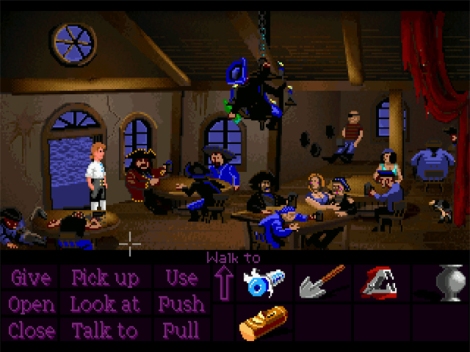
I’ve mentioned this story several times already and it still brings a smile to my face whenever I recall it. When I was nine, my father chose to get me my first Amiga for Christmas and after spending ages looking at all the floppy discs that came with the hardware, I finally decided to give The Secret of Monkey Island a try. He asked what I was doing and I showed him the game, then gradually both he and my grandfather got sucked into playing it too. I remember being so proud of myself because I’d managed to figure out the grogs-and-mugs puzzle before they did (sorry Dad!).
I fell in love with adventures that day and afterwards I devoured anything in the genre I could get my hands on, particularly titles by LucasArts (damn you, Disney). I went sailing around the Caribbean with Guybrush (and envied Elaine) through the rest of the Monkey Island series; I learnt how to become a wizard with a horny and slightly sarcastic teenager in Simon the Sorcerer; and I searched for Princess Cassima with Prince Alexander in King’s Quest. My love of books and vivid imagination had been combined in a medium that I could not only read, but experience and influence for myself.
The Secret of Monkey Island started my love for adventure games.
Unfortunately however, as you grow older you start to realise society may not view you or your hobby in the same way that you do; and against your better judgement, you try to change the person you are just to fit in. When I progressed into secondary school it was hard enough being the shy, awkward, quiet kid who always sat the corner so as not to be noticed. But add to that the fact that I liked to play video games and preferred to spend time with the boys rather than my female counterparts, and it resulted in being quite a difficult period in my life.
To turn myself into something more ‘acceptable’, I gave up the games and forced myself to make friends with a group of girls when I became a teenager. I went from spending the weekend with the likes of Guybrush and Simon to instead hanging around shopping centres, going to sleepovers and dressing up for the local under-eighteen-night (admit it, you all did it). But while this change seemed to make me more tolerable to my peers, I can’t say it ever made me completely happy; and my teenage years aren’t exactly something I look back on with a great deal of fondness.
When you’re growing up, sometimes you feel you have to change to fit in.
I stopped playing video games for around eight years although I guiltily dipped back into them every once in a while, but after leaving college I grew apart from my female friends because I really had nothing in common with them. I preferred being a tomboy, I didn’t want to go out shopping with them every weekend, and I wasn’t particularly interested in any of their other ‘girly’ activities. Instead, I started making more male acquaintances of which there was one I frequently hung out with. Over time it became commonplace for me to watch him playing on his PlayStation 2 whenever we got bored with the television, and one day in 2004 he turned up at my apartment with an Xbox under his arm along with a copy of Fable.
That was the day I turned into a gamer who wasn’t ashamed to admit it. After thirty-minutes of playing I was hooked; my friend and I spent the next week ploughing through the title, trying to find every side-mission, figure out how to get through all the demon doors and meeting as many residents of Albion as possible. You know everyone has those gaming moments they’ll never forget? Well, Fable plays a massive part in mine.
After finding Fable, I no longer felt ashamed admitting I was a gamer.
For those who have never touched this role-playing game, let me give you a brief overview. You take control of a protagonist known only as the Hero of Oakvale after your home is raided by bandits and your entire family is killed, and you’re rescued by the wizard Maze who sees great potential in you. As with any RPG, it’s necessary to complete quests in order to advance the plot with optional side-missions if you wish to gain gold or renown, and your character can be levelled up by collecting Strength, Skill and Will experience. The world of Albion is dotted with activities other than quests: for example, towns have houses that can be bought and rented if you wish to become a property tycoon, or you can woo and marry someone of the same or opposite sex if you’re feeling amorous.
The thing that fascinated me most about Fable was the sense of character development as it was the first time I’d seen anything with a real alignment mechanic. Good deeds such as saving villagers result in you becoming a light-featured champion with a halo above your head and butterflies fluttering around you; while evil acts such as eating crunchy chicks see you turn with glowing red eyes and a malevolent haze around your legs. Other actions affect your Hero also; eating too much and drinking excessive amounts of beer will make you ill (as we’re all too aware in real life), and clothing can change how townspeople react to you depending on how attractive or scary you appear.
Whenever I play games with alignment, I tend to go for the good side…
Fable took around four years to create by a team of seventy developers at Big Blue Box, a satellite studio of Lionhead. This developer was originally formed as a breakaway from Bullfrog and was founded by Peter Molyneux in 1996. The majority of gamers know who this guy is and you’ve probably played one of his titles before; there aren’t many people who won’t have heard of classics such as Populous and Dungeon Keeper, or the upcoming ‘regeneration of the god game’ Godus that was funded via Kickstarter back in December 2012.
Despite the critical and financial success of his titles, Molyneux has managed to get a bit of a reputation for being somewhat over-ambitious – a trait that has caused many to lose faith in him. In the past he has issued enthusiastic descriptions of games under development, only to cause uproar with the gaming public when his promises weren’t delivered in the final version. This goes all the way back to Black & White in 2001 but the most well-known case is with Fable, when it was released in 2004 without many of the features Molyneux had talked about in interviews during its development.
Molyneux is known throughout the gaming community as being over-ambitious.
For example, he had previously mentioned that the Hero of Oakvale’s children would be significant in the title and that trees would grow as time passed, but both were completely missing from the released title. Molyneux reacted to complaints by posting a public apology on the official Lionhead forums in which he regretted his overhyping and the missing promises. He went on to say: “I have come to realise that I should not talk about features too early so I am considering not talking about games as early as I do… I will not mention them to the outside world until we’ve implemented and tested them, and they are a reality.”
Three years later, Molyneux said in an article with GameSpot: “After Fable, there was a pretty dark time where people looked at the game and compared it with what I said in the press, and they felt cheated. I realised I couldn’t keep on doing that. But that was very much a reflection of how we worked, because what I was talking about in the press was what we were experimenting with at that moment, and a lot of those experiments would sort of come out as you were making the game… People understandably get enormously upset about it… I think a lot of what we do is realise what we’ve done wrong and work to try and make that right. It’s far better than thinking that we get things right all the time.”
Molyneux said children would be significant in Fable, but this feature was missing.
So there tends to be a bit of a love-hate with both Molyneux and Fable for many gamers. But for myself, if it wasn’t for the developer and his title I wouldn’t be here writing this today.
Sure he may be over-ambitious, but where’s the problem in reaching for the stars and challenging the status-quo? He might make grand promises that don’t always work out, but what’s wrong with dreaming, and having enthusiasm and big ideas? I’m far more intrigued by and interested in a developer who takes risks, rather than those who churn out carbon-copy titles with little vision; I understand there are a lot of people out there who enjoy them, but in my opinion the world doesn’t need another Call of Duty or FIFA. Give me someone who’s going to push the boundaries, be inventive time after time, and create stories that remain in the minds and hearts of those who experience them for years afterwards.
If it weren’t for Fable, I honestly believe I wouldn’t be here creating this post. I wouldn’t be the gamer I am today and I’d be less happy with the person I’ve grown into since leaving school. I wouldn’t write for 1001-Up.com or The Mental Attic or have been fortunate enough to experience the wonderful times we’ve had together as a team. And, most significantly for me, I wouldn’t have made some of the great friends I’ve gotten to know both in person and online. That may sound like a bit of a grandiose statement and it’s possible there’s a touch of rose-tinted-ness here but, alongside finding The Secret of Monkey Island aged nine, the moment I picked up Fable was one that really shaped me.
There’s only one thing that makes my memory of the game a little melancholy: the fact I can’t go back and it’s impossible to experience it all over again for the first time. It’s extremely unlikely that anything will be able to capture that feeling of when I first stepped into the Hero of Oakvale’s shoes or met the mysterious Theresa, Blind Seeress. But that’s not to say I’m not going to try; I recently bought Fable Anniversary and Phil and I will be playing it together very soon. It won’t be the same, but I’m looking forward to experiencing the wonder of Albion through a new player’s eyes.
As is obvious from the size of our adventure category, I’m still a big fan of the genre. Fable gave me the opportunity to meet people with similar loves and they’ve have introduced me to newer titles that now reside in my heart alongside the classics, such as To The Moon and Cognition: An Erica Reed Thriller. Lionhead’s RPG and its creator taught me that it’s good to dream big and, even if your ideas don’t always come to fruition, you shouldn’t let that stop you from being ambitious and pushing forward. I’d love to meet him one day, shake his hand and explain how much his ambition has done for me.
So, thank you to Peter Molyneux and the rest of the team that created the wonder that is Fable. I couldn’t have done this without you.
On my way to work one morning last week, I came across an article in the newspaper that caught both my attention and anger. I normally only glance at the headlines because the usual superficial stories of celebrity gossip don’t hold much interest, but there was a small piece about a game available on Google Play that I made a point of reading all the way through. It existed under the heading: Liposuction game for 9yo girls ‘awful and reckless’.
Later on I did some further digging and found out that Plastic Surgery had been removed, although it was estimated that it had already been installed between 500,000 and a million times. The game’s description was advertised as the following (the bad grammar comes courtesy of the developer): “Barbara likes to eat a lot of burgers and chocolates and once she found that she looks ugly. She can’t make it up with situation any additional second. And today plastic surgeon is going to make operation on her body and face to return cute Barbara’s look. She is afraid of this.”
At the same time, Plastic Surgery for Barbie was taken down from the App Store. Recommended as being suitable for children aged nine and over and free to download, it instructed young players to perform plastic surgery on the image of a woman resembling Mattel’s doll who has ‘so much weight that no diet can help her’. Both apps were pulled after Everyday Sexism launched a campaign and protests were made by four-thousand users on Twitter.
Here’s a message for anyone who has just read the above and is now starting to worry that this is going to be yet another post on women and sexism in video games: trust me, it isn’t. I said my piece on that particular topic in a lengthy article last year and I don’t particularly feel the need to explain my opinions once again. This post is about something different: it’s about body-image and self-confidence, a subject which could affect anyone regardless of their gender.
To give you some more background, here are some additional details about the apps. The games themselves are quite simple: the player taps on a surgical tool, then on the character’s body to use it. Liposuction involves local anaesthetic, a scalpel and an implement that looks like a bicycle pump, and ‘helpful’ arrows show you what to do. The poorly-programmed controls and slow animations means that it takes around ten minutes to finish, and once surgery is complete there’s an opportunity to play dress-up with a choice of new hairstyles, dresses and shoes.
It’s bad enough that modern media promotes the perception that all you need to be successful is youth, a good body and a beautiful face, but to so obviously market this message to children? I can’t explain how disappointed this makes me. Hell, if you’re old, overweight or unattractive then you may as well forget about getting anywhere in life – but if you want a quick fix, then why not go under the knife and cut all your troubles away! It’s not just apps like these or video games in general, but all forms of media that promote these ideas. Try to think of one that hasn’t used beauty, sex or a set of toned abs for promotion at least once and you’ll struggle to come up with an example.
It’s not something I like to talk about but I was a real ugly duckling as a kid. I was awkward, shy and had several problems that prevented me from being what you’d call a ‘conventionally pretty’ child (I’d really rather not go into them here). Add to that the fact I liked to play video games and preferred to hang out with the boys rather than my female counterparts, and it resulted in quite a difficult time growing up. My parents, while great, were firm believers in ‘tough love’ and felt that pulling me apart on my appearance would give me additional motivation to change it; and this, combined with being teased at school, was enough to make me feel almost worthless.
By writing this admission I’m not asking for your sympathy or looking for attention – indeed, I’m sure many people can relate to my own tale of inadequacy and have one of their own. I’m just trying to give some context about why I feel so strongly about this subject and had such a negative reaction when I read about these Plastic Surgery games. It took me many years to become comfortable in my own skin and my experiences are what have made me the person I am today; but, even though I’m now quite happy with what I see in the mirror, every once in a while those old insecurities bubble to the surface and it can be a real battle to push them back down again. I may have had a tough time and still have to deal with the effects of that occasionally, but I can only imagine how difficult it must be for the children of today.
They’re bombarded with images of the ‘ideal beauty’ from such any early age and through so many more media channels than were available when I was young. I’m not a parent myself and so maybe not the best person to comment, but when I think of my friends’ children I do worry about how this will affect them. A study by the National Eating Disorders Association (NEDA) found that the negative effect of media on body-image appears to be greater among young adults than in children and adolescents; and this may suggest that long-term exposure during childhood lays the foundation for the insecurities in early adulthood.
There seems to be very little emphasis in today’s media on learning to love yourself or your body, and being happy with who you are. The attitude that a person can never be ‘too rich or too thin’ is all too prevalent and this makes it extremely difficult for anyone – male or female – to achieve any kind of contentment with their physical appearance. Sadly it’s not something that can be easily changed because it’s so engrained in modern society and, let’s face it: whilst sex continues to sell, the media is going to keep using these images to rake the money in.
But that’s not to say that we can each do something about it. It’s so hard to change your mind-set when everything around you says you must be conventionally beautiful to succeed, but it’s important to remember that true beauty is always in the eye of the beholder. Yes, it’s cliché, but Margaret Wolf Hungerford hit the nail on the head when she first said that famous phrase. What really makes a person attractive is how they respond to the world and react to others around them, not their appearance.
This isn’t just something I’m saying for the sake of this post but advice I truly believe in. I have crushes that some others may find weird but the attraction is because of who that person is, rather than what they look like. There’s an actor whom I think is extremely attractive because of his wicked sense of humour; a TV personality who’s gorgeous because he seems like a genuinely nice guy; and a video game developer I’d love to meet because I admire him for all he’s achieved. What these people have in common is that they may not fit society’s view of what’s considered to be beautiful, but that makes them nonetheless appealing to me.
Give me Ragnar Tørnquist over Brad Pitt any day. The fact that this man has the creativity to come up with one of the most amazing stories in video game history makes him seriously sexy in my book. (If you’re reading this Ragnar, feel free to give me a call sometime.)
While I applaud Google Play and the App Store for removing the Plastic Surgery games, I can’t help feeling that more could have been done. The latter version was available for a year before it was taken down; it took four-thousand tweets before anything happened; and it seems like Apple’s decision may have been more to do with a possible trademark infringement than anything else – and that’s after a potential million children had downloaded the app. At the same time as being overzealous in its approval process (removing titles such as that by prize-winning cartoonist Mark Fiore after accusations of ‘ridiculing public figures’) the company lets many more like these liposuction games slip through the net.
Developers like those of Plastic Surgery make me afraid for the world and where the future of media is heading. Video games of any kind – apps or otherwise – have the potential to be a great positive medium, so why is the industry not taking advantage of that? Children shouldn’t be playing things that make them feel inadequate or that the most important thing in life is to be beautiful; and there’s no reason why games can’t potentially teach them how to overcome their body issues, or how the media distorts reality, or that it’s more important to be beautiful on the inside.
Every child deserves to feel special, regardless of their appearance, size, gender or background, and nobody should be made to feel as if they’re insignificant just because of the way they look. If we all just took the time to get to know others for who they really are rather than how they appear to be on the outside, then we may find that there are many more beautiful people in the world than we ever realised existed.
I’ll end this post with a quote by Markus Zusak, the author of one of my favourite books: “Sometimes people are beautiful. Not in looks. Not in what they say. Just in what they are.”
Point of view switch helps connect with the characters.
Fantastic use of Oxford locations and history.
The Bad
Character portraits aren’t very good looking.
Gray Matter is a Point & Click adventure game developed by Wizarbox, published by DTP Entertainment, and most importantly, designed by the awesome Jane Jensen, creator of the Gabriel Knight trilogy and Phoenix Online Studios’ Story Consultant for their fantastic episodic game Cognition. Continue reading Gray Matter Review
It’s that time again. Time for you to see me shiver & scream playing horror games. This time we’re playing one of my favourites, Dead Space, the first in the series and the best of the 3 (so far) in terms of horror. Continue reading Dead Space Scarethrough